Urban Infrastructure Risk Coordination System (UIRCS)
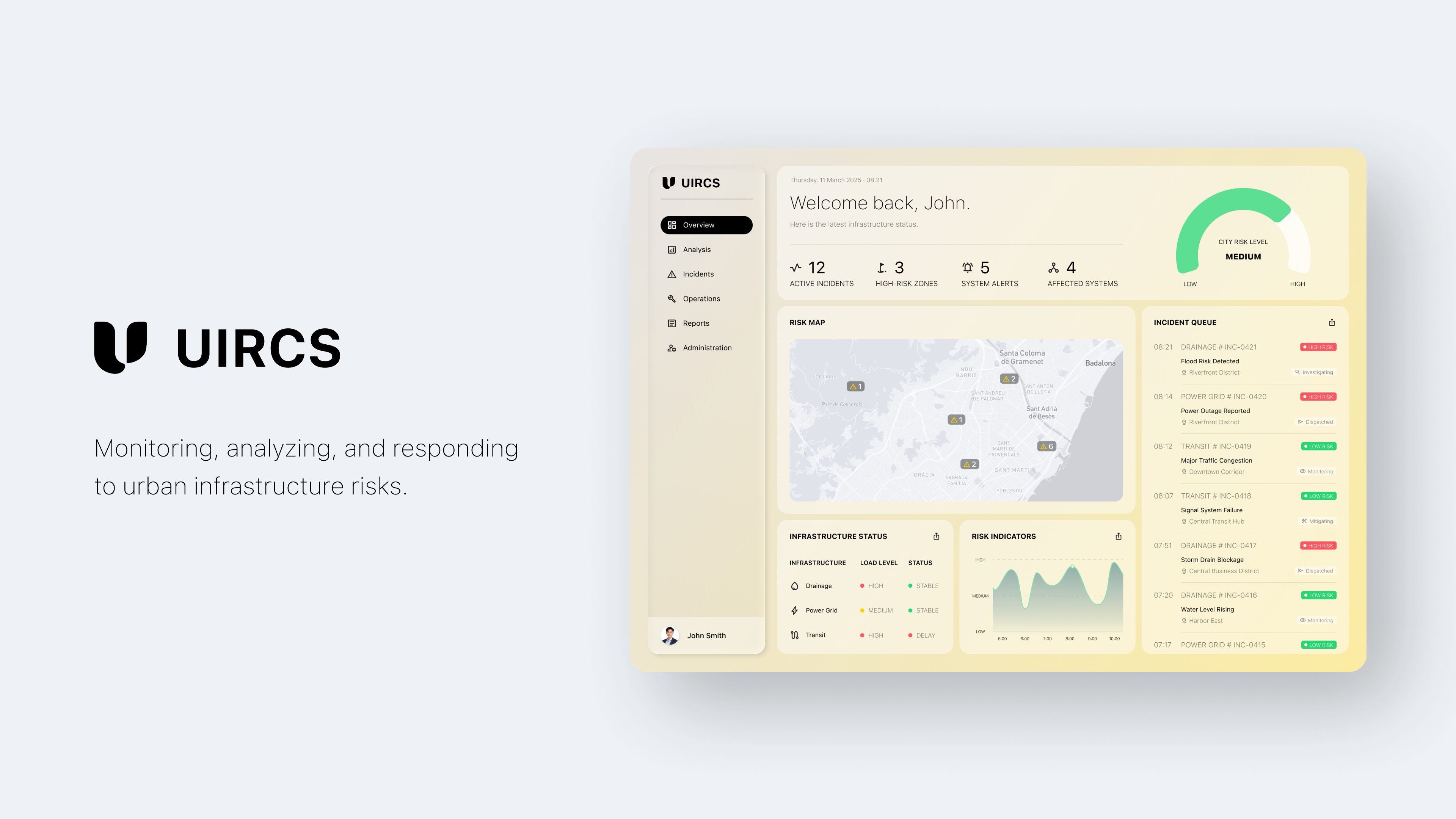
Urban Infrastructure Risk Coordination System (UIRCS) is an enterprise-grade operational platform designed to coordinate infrastructure risk management within a municipal governance environment.
Rather than functioning as a reporting dashboard, the system embeds predictive risk intelligence directly into cross-department workflows—linking monitoring signals, authorization logic, and execution pathways into a unified operational lifecycle.
My role focused on system architecture design, permission modeling, workflow orchestration, and embedding AI across both predictive and execution layers.
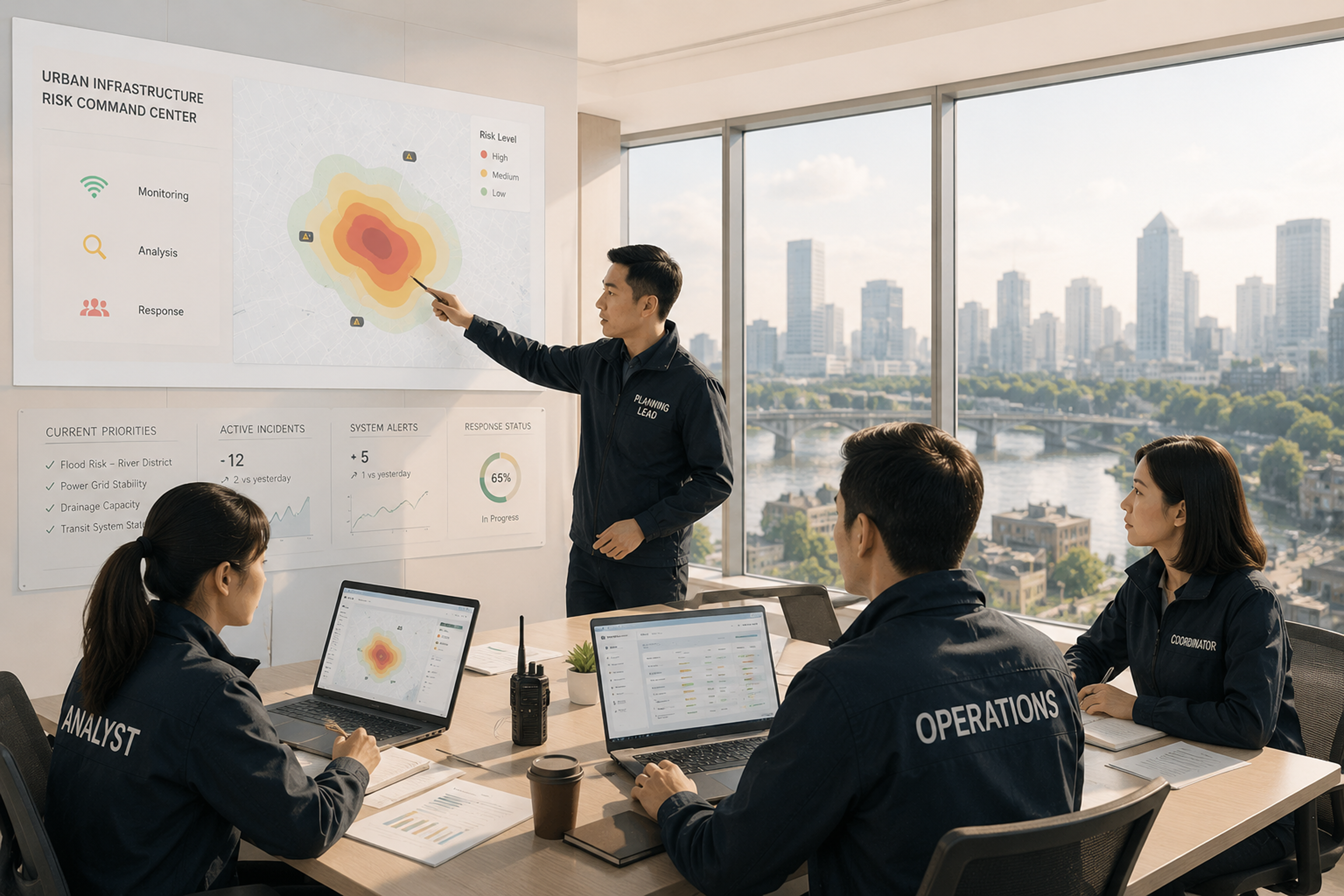
Urban infrastructure risk management challenges emerge from both structural and organizational conditions.
At a systems level, monitoring tools and risk signals operate in fragmented silos without a unified coordination model. At a governance level, decision authority and escalation pathways are formally defined but procedurally rigid, limiting anticipatory response.
Understanding both dimensions was critical in framing the problem before designing a structural intervention.
1 / Structural Fragmentation
Within this metropolitan administrative environment, infrastructure operations are distributed across independent departments—including drainage management, power grid control, and public transportation oversight. While each unit maintains dedicated monitoring systems, risk intelligence remains structurally fragmented across organizational boundaries.
Existing systems function primarily as reporting tools rather than integrated coordination platforms. During extreme rainfall events, early warning indicators are often present but lack a unified operational framework for activation. Escalation therefore depends on manual consolidation and hierarchical approval chains.
As a result, predictive signals fail to translate into coordinated action, and infrastructure response remains reactive rather than anticipatory.

2 / Governance Structure
Infrastructure risk management operates within a layered governance structure composed of operational departments, an inter-department coordination authority, and executive leadership.
Decision rights and authorization boundaries across these layers shape how risk signals are escalated and how interventions are approved. While formal authority exists, coordination remains structurally procedural rather than intelligence-driven.
Understanding this governance structure was critical in designing a system that aligns predictive intelligence with institutional decision-making.

Under high-risk conditions, infrastructure signals are detected within departmental systems but remain confined to localized workflows. Monitoring, authorization, and execution operate as sequential and disconnected phases rather than an integrated lifecycle.
Escalation relies on manual reporting and hierarchical approval processes, introducing latency and increasing cascade exposure across interdependent infrastructure domains.
The absence of a unified operational model prevents risk signals from being correlated, prioritized, and activated in real time.

To resolve structural fragmentation, UIRCS shifts infrastructure management from isolated monitoring toward an integrated operational architecture.
Rather than introducing another reporting layer, the system embeds predictive intelligence directly within coordination workflows—formalizing a unified risk lifecycle that connects detection, authorization, intervention, and audit.
This strategic shift reframes infrastructure governance from reactive escalation toward structured, anticipatory coordination.

UIRCS is structured as a progressive system modeling framework. Instead of assembling independent modules, the architecture formalizes operational relationships, governance logic, and execution workflows into a unified risk lifecycle.

1 / Operational Model
UIRCS models urban infrastructure risk as an interconnected operational system rather than isolated alerts. Drainage capacity, power load stability, and transportation continuity are treated as linked domains with measurable risk indicators.
Risk signals are formalized within a shared operational model, enabling cross-domain correlation and unified scoring across departments.
This modeling layer transforms fragmented monitoring into structured, relational intelligence.
2 / Governance Model
Risk thresholds trigger predefined intervention pathways governed by a structured authorization matrix. Each intervention type is mapped to explicit decision rights and accountability roles.
High-impact actions require executive validation, while lower-risk responses operate within policy-defined guardrails. All interventions are recorded through an auditable event log.
Predictive intelligence functions as a decision-calibration mechanism rather than autonomous control.
3 / Workflow Model
Predictive modeling is directly integrated with operational execution through a structured workflow architecture. Risk scoring, playbook generation, and resource allocation are connected within a unified lifecycle.
Interventions no longer depend on sequential escalation chains but follow explicit lifecycle stages, reducing latency and improving coordination clarity.
4 / Interface Layering
The interface architecture reflects this operational logic through four role-aligned layers: Command, Investigation, Operations, and Executive.
Each layer supports distinct responsibilities while maintaining shared access to the unified operational model. The interface visualizes governance structure rather than defining it.

The information architecture translates the system model into a structured navigational framework.
Rather than organizing the platform around departments or isolated dashboards, the structure aligns with the unified risk lifecycle and defined governance roles. Primary navigation reflects lifecycle progression—from detection to authorization, intervention, and audit—ensuring structural continuity across operational layers.
Role-based access logic determines data visibility, action privileges, and information density. This approach preserves a shared operational model while maintaining clarity between responsibility levels.
The UIRCS platform organizes operational intelligence into six functional modules supporting monitoring, investigation, incident response, operational coordination, reporting, and governance oversight.

The interface design operationalizes the information architecture into role-aligned interaction environments.
Instead of consolidating all data into a single control dashboard, the system differentiates visibility, data density, and action controls according to decision authority and operational responsibility.
Four role-aligned layers—Command, Investigation, Operations, and Executive—translate governance structure into distinct interaction contexts. Each layer supports a specific objective: situational awareness, contextual analysis, coordinated execution, or strategic oversight.
The interface reflects the system’s operational logic rather than redefining it.
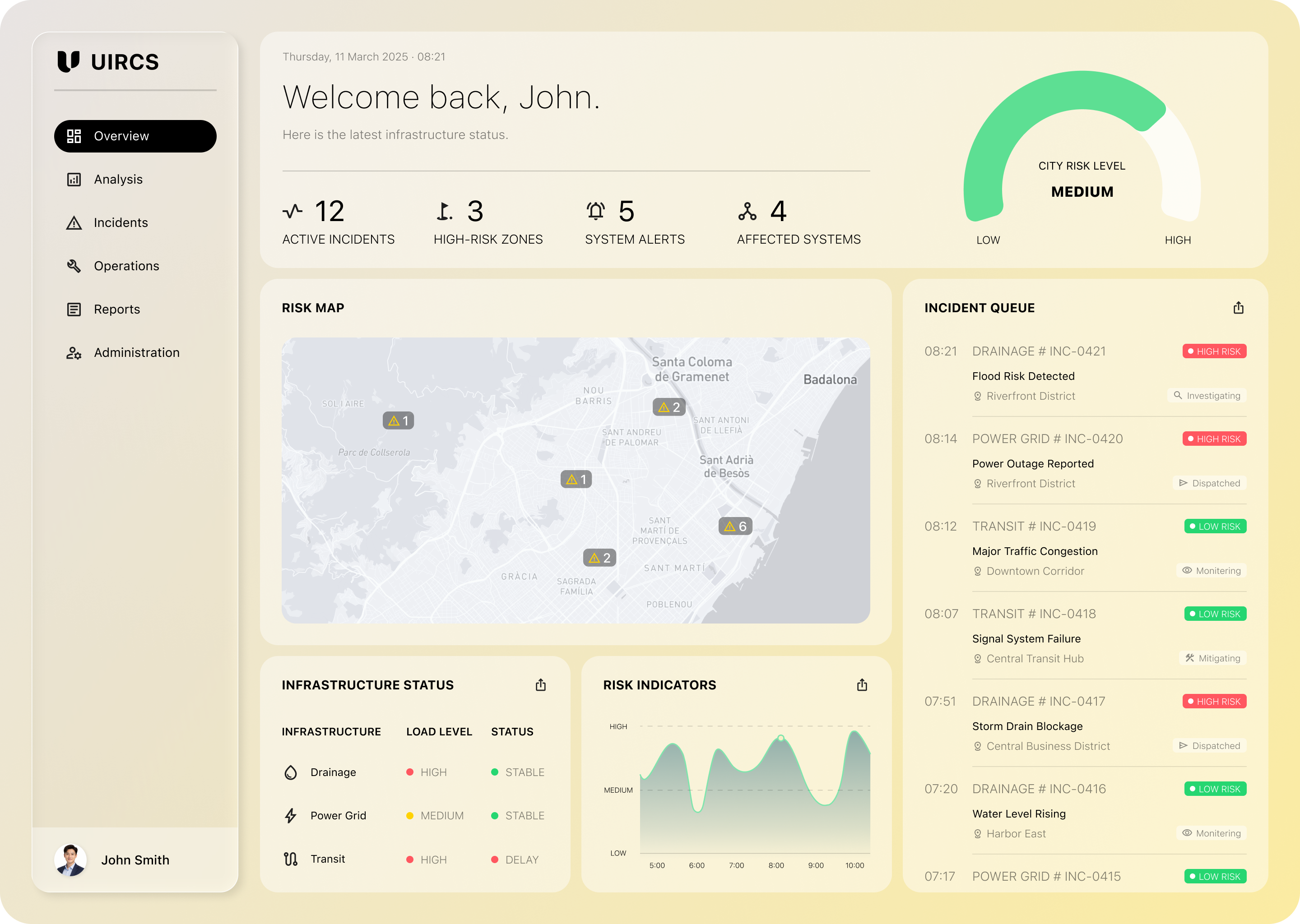
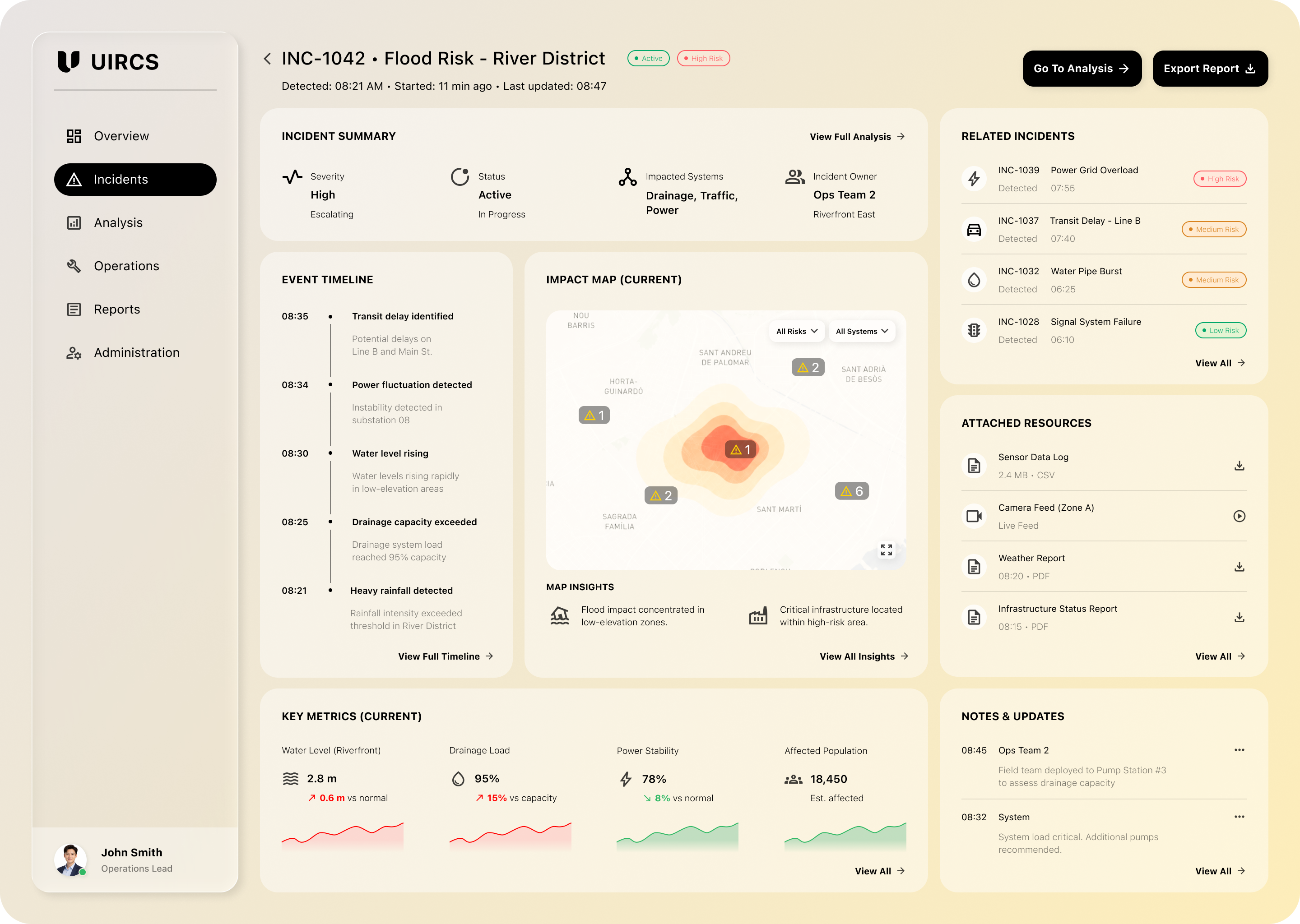
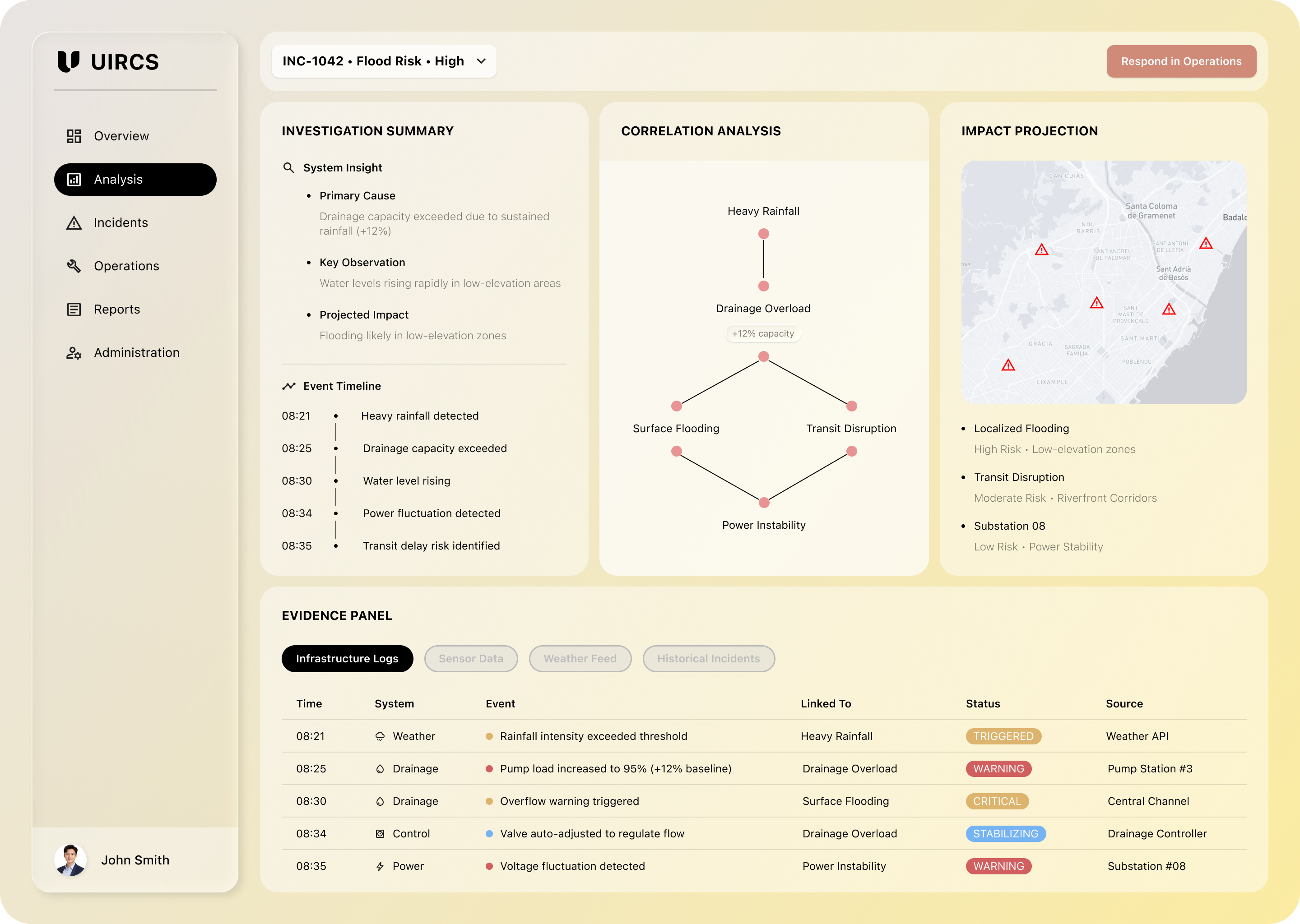
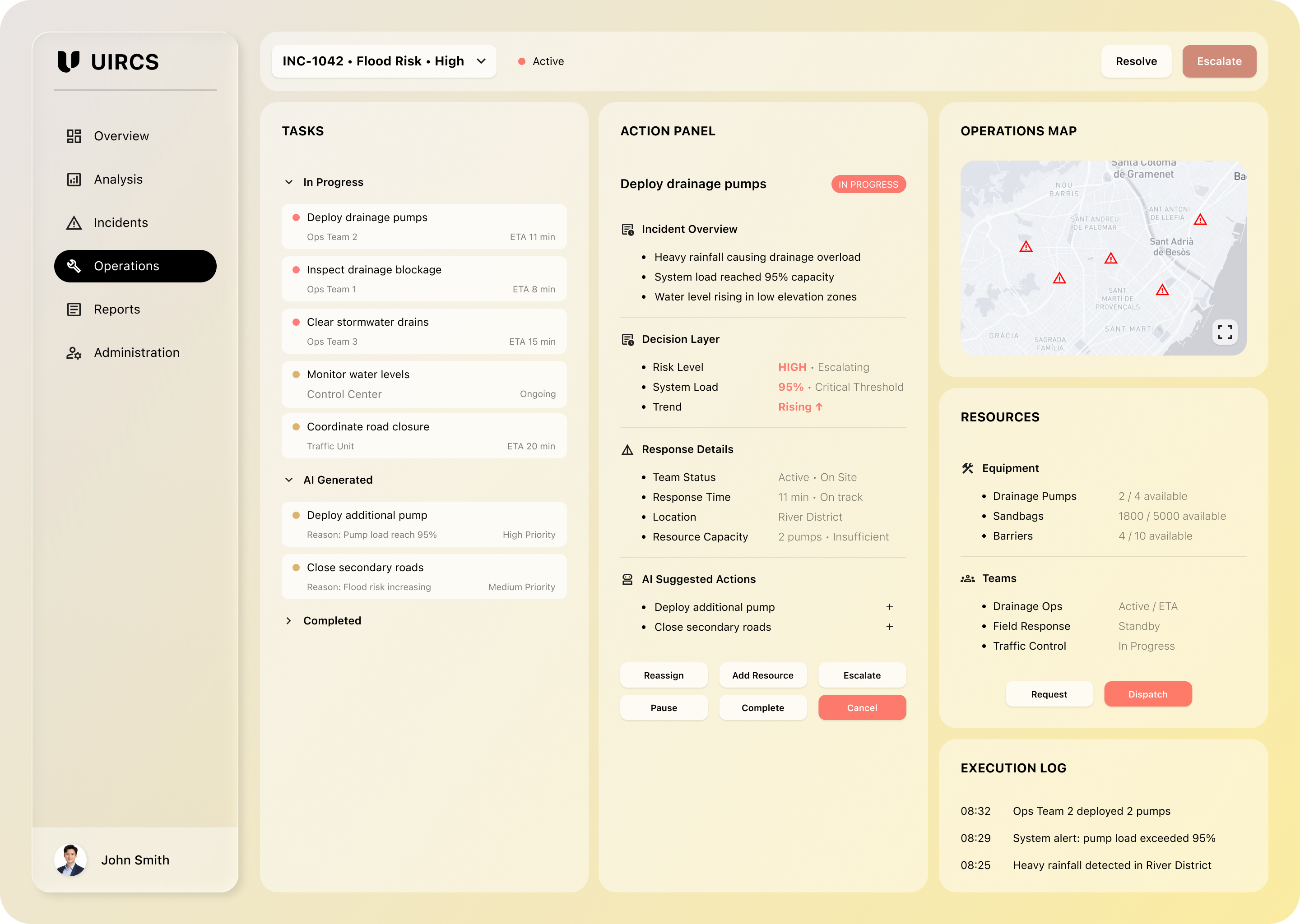
Early system prototypes revealed tensions between predictive automation, decision authority, and cross-department coordination. Iteration therefore focused less on interface aesthetics and more on governance clarity, trust calibration, and operational transparency.
1 / AI Trust Calibration
Initial user testing indicated hesitation toward AI-generated recommendations due to limited interpretability.
The investigation layer was redesigned to expose risk confidence scores, supporting data references, and projected impact simulations. This shifted AI from a black-box advisor to a calibrated decision-support mechanism.

2 / Governance Optimization
Early authorization structures introduced escalation bottlenecks across departments.
The permission matrix was refined to reduce redundant approval layers while preserving accountability through explicit decision mapping and audit traceability.
3 / Visible Automation Controls
Background automation improved efficiency but reduced operator awareness.
Automated interventions were redesigned as visible system events with traceable logs and override capabilities, reinforcing user control and institutional transparency.
These refinements strengthened the system’s balance between predictive intelligence, institutional accountability, and human oversight.
Designing UIRCS reinforced that enterprise systems are defined less by interface complexity and more by structural clarity. The most significant challenges did not emerge from visual decisions, but from modeling governance boundaries, calibrating trust in predictive systems, and aligning cross-department accountability.
This project deepened my understanding that AI only becomes meaningful when embedded within operational workflows and decision authority structures. Predictive intelligence must be contextualized within permission models and execution pathways to support real-world action.
Ultimately, enterprise design is a continuous negotiation between automation and human oversight—prioritizing transparency, institutional trust, and operational responsibility over surface-level efficiency.